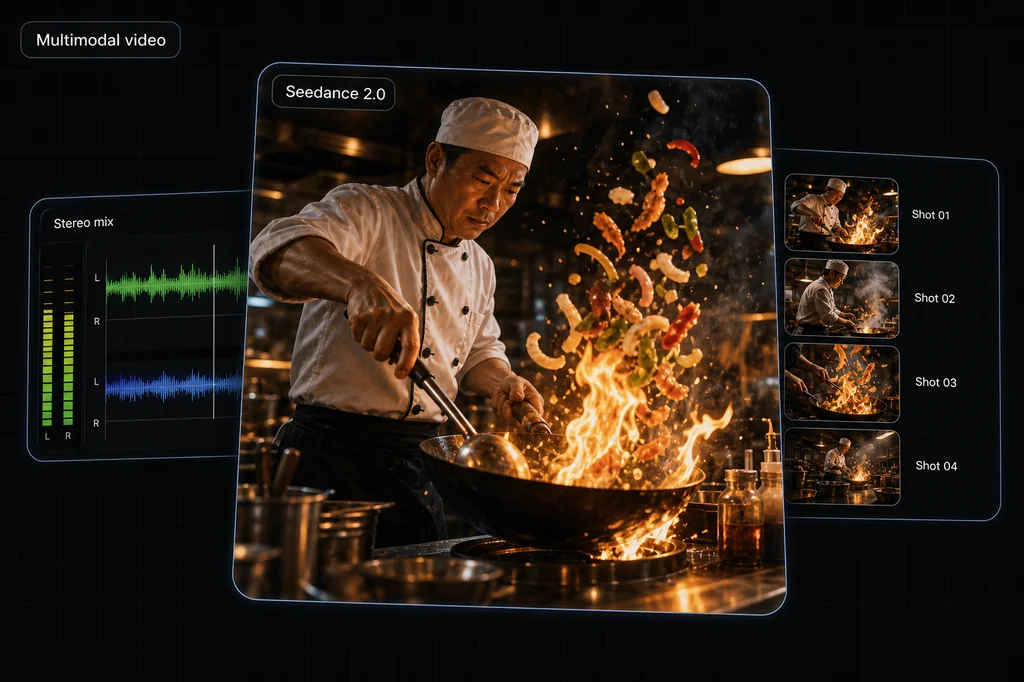
Seedance 2.0 is active on Masonry for text-to-video and image-to-video. This guide preserves 16 shipped clips and their prompt directions, then separates what those files demonstrate from what the current route actually exposes.
ByteDance's official launch notes describe a broader provider model: text, image, audio, and video references; editing and extension; dual-channel audio; and 15-second multi-shot output. Masonry's current seedance-2-0 route is narrower. Its checked CLI contract exposes a prompt, seed, output size, first image, last image, and audio opt-out. Do not assume every provider capability is available on every surface. The newer Seedance 2.5 route adds reference-to-video and a stated 30-second ceiling, so recheck which version you are calling before reusing a prompt from this guide.
Quick answer
- Use one observable action arc. Name the subject, movement, camera, environment, light, audio, continuity constraints, and final beat.
- Use timed shots for a sequence. Each shot should reveal one new piece of information; a long screenplay is not automatically a better prompt.
- Start from an image when identity matters. Masonry accepts a first image and optional last image on the current route.
- Treat timing as intent in the CLI. ByteDance documents 15-second multi-shot output, but Masonry's checked model-specific contract does not expose a duration flag.
- Judge the full file. Review anatomy, identity, physics, camera continuity, audio, duration, dimensions, and cost per accepted clip.
Evidence boundary: the page contains 16 first-hand shipped video assets and their stored prompt directions. The original jobs, seeds, input references, queue times, credits, retries, rejected candidates, and complete generation logs are not preserved here. The clips can support visible observations and prompt-design lessons; they cannot establish a reliability rate, permanent leaderboard position, or universal model win.
Current Masonry controls
The route and parameters below were checked with the live Masonry CLI on August 4, 2026:
| Control | Current route behavior | Production implication |
|---|---|---|
| Route | seedance-2-0 | Pin the exact key and recheck it before a batch. |
| Capabilities | Text-to-video, image-to-video | Broader provider reference/editing features are not listed on this Masonry route. |
| Prompt | Required | Describe observable action, camera, light, audio, and rejection constraints. |
| First/last frame | --image, optional --last-image | Use approved keyframes when opening composition or product identity matters. |
| Size | Twelve dimensions from 992×432 through 720×1280 | Pick the delivery frame before writing camera movement. |
| Seed | Optional integer | Record it for reruns, but still inspect every result. |
| Audio | On by default; --no-audio opts out | Listen for synchronization, artifacts, unwanted speech, and unsafe claims. |
| Duration | No model-specific CLI flag | Treat timed prompt blocks as creative direction and inspect the delivered duration. |
The underlying provider API reference exposes additional endpoint-specific controls, including duration and reference-to-video inputs. That schema does not override Masonry's live model contract.
Best Seedance 2.0 Prompts and Examples
The 16 stored examples range from dense multi-shot briefs to short UGC prompts. Copy their structure selectively. A shipped clip shows one delivered result, not that every instruction succeeded or will repeat.
1. The Noodle Master: Kung Fu Cooking in Motion
SUBJECTS Subject 1: Lean kung fu chef with short, sharp-cut hair and defined jawline. Wears a modernized Chinese chef outfit fused with martial arts attire: fitted sleeveless upper garment with mandarin collar, dark matte fabric with subtle sheen; forearms wrapped with cloth bands for grip; loose tapered pants allowing wide stances; soft-soled shoes for silent footwork. Limbs slightly exaggerated in length; wrists highly flexible, elbows explosive. Movements follow a clear martial rhythm (pause → burst → lock), with grounded footwork and fast pivots. ENVIRONMENT Traditional Chinese open-fire stove setup; iron wok fixed on stove; reflective metal counter; blue-and-white porcelain bowl placed in foreground center. Warm overhead light combined with intense dynamic firelight; light oil smoke and visible heat distortion. MOOD High tension, aggressive, but controlled and precise; performance feels intentional and elegant rather than chaotic. TIMELINE 0:00-0:02: Extreme close-up, wide-angle POV. The chef stands on the ground behind the counter, steps in, compresses posture, then snaps his head up to lock eyes with camera. Both hands grip dough—he stretches it in one clean pull, folds once, then pulls again. The dough transitions from a single mass into a small number of even strands. 0:02-0:05: Cut. Slight handheld motion. The chef keeps full control of the noodle bundle in both hands, stretching and aligning the strands into clean, parallel lines through fold → align → stretch cycles. Around 8–12 thin strands extend in smooth arcs, passing close to the lens. He finishes the pull and places the aligned noodle bundle neatly onto the counter in front of him. 0:05-0:07: Move (slight recoil then stabilize). The chef lowers into a sliding step behind the counter. One palm sweeps across the surface—shrimp and greens lift and travel in a controlled arc into the wok. The wok remains on the stove; the chef grips only the handle. Any stray ingredient is clearly caught and redirected into the wok. 0:07-0:10: Continuous shot. The chef controls the wok only through handle movement and qi force—no hands enter the wok. He lifts, tilts, and snaps the wok using wrist power; ingredients rise, rotate, and fall back into the wok. His elbow strikes the stove edge—sparks burst. He compresses the wok into the flame, then reverses to pull the flame upward into a second controlled flare. 0:10-0:12: Match move tracking. The chef pivots while holding the wok handle. With the other hand, he picks up the same noodle bundle from the counter and feeds it directly into the wok in one controlled motion. He immediately resumes tossing using the wok—three clean toss cycles (fast → faster → stop). Shrimp, greens, and noodles integrate visibly; sauce coats evenly. 0:12-0:15: Cut to stabilized POV. Sudden full stop. The chef tilts the wok and slides the finished dish into the porcelain bowl—visible: evenly coated noodles, plump shrimp, glossy greens. He lifts and presents the bowl directly toward the camera until it fills the frame. A finger taps the rim—subtle vibration. Steam rises rapidly, expanding until it fully covers the lens for a clean fade-out.
Why Does This Work?
This works as a production brief because it is built like a martial arts film, not a cooking description. The timeline has a clear tension arc: compression, release, and controlled resolution. Each shot has a physical logic—the chef’s body language drives the camera, not the other way around. The “pause → burst → lock” rhythm gives the reviewer named beats to check across cuts. The counter as a permanent visual barrier creates depth without requiring another staging change.
The final bowl presentation and steam fade-out give the model a clean, unambiguous ending instruction, which is one of the hardest things to communicate in generative video prompts. Sound and fire are embedded into the action rather than described separately, so the atmosphere builds from within the scene rather than being layered on top.
2. Cyber Beetle: A Macro Cinematic Chase Through the Forest Floor
FORMAT 15s / 6 SHOTS / single continuous chase energy / no dialogue STYLE Macro jungle floor, towering grass blades, dew drops, damp earth vs neon pink cyber-implants, photorealistic macro cinematic. TIMELINE 0:00-0:02: Dive from the canopy of a giant fern down to a cybernetically enhanced rhinoceros beetle sprinting across a fallen, moss-covered log. 0:02-0:04: Camera tracks parallel to the beetle's mechanical legs, sweeps under its glowing pink thorax, and snaps to the spinning micro-rotors on its back. 0:04-0:07: A heavy rain droplet dislodges a pebble from above; the beetle initiates a thruster-assisted sidestep, scraping its metallic horn against a fungal stalk. 0:07-0:10: The path dives into a dense thicket of thorny briars, spiderwebs, and overlapping leaves; the camera seamlessly navigates the micro-labyrinth. 0:10-0:13: The beetle bursts from the thicket into a clearing, a splash of muddy dew hitting the lens as its optical sensors flash tactical warnings. 0:13-0:15: Camera pulls back exponentially, transitioning from the micro scale to reveal an immense, sprawling bioluminescent greenhouse, the beetle lost in the glowing flora.
Why Does This Work?
This works because it treats scale as the central character. The prompt is not really about the beetle. It is about the contrast between the organic micro-world and the mechanical implants invading it, and every shot is designed to make that contrast feel physical and tactile. The camera moves are written as chase energy rather than observation, which keeps the generation kinetic across all six shots without needing a human subject to carry momentum.
Specific physical events drive each cut: a falling droplet, a scraping horn, a lens splash. That gives the model concrete action triggers instead of vague atmospheric descriptions. The exponential pull-back in the final shot recontextualizes everything before it. The bioluminescent greenhouse reveal works as both a visual payoff and a tonal shift, moving from tension to wonder in a single camera move.
3. Storm Approach: Fighter Jet Landing on an Aircraft Carrier at Sea
FORMAT 15s / 6 SHOTS / cinematic naval landing / no dialogue STYLE Photoreal war-drama realism, steel-grey ocean, storm clouds, wet flight deck, cold blue light with orange deck signals, heavy wind, realistic jet weight. TIMELINE 0:00-0:02: Extremely wide aerial over a vast dark ocean at dusk, an aircraft carrier cutting through rough water, a tiny fighter jet approaching from far behind through mist and sea spray. 0:02-0:04: Long-lens rear tracking on the fighter jet descending toward the deck, landing gear dropping, vapor trailing from the wings, carrier deck lights blinking through rain haze. 0:04-0:06: Low side deck shot as crew in color-coded rain gear crouch against the wind, the jet roars overhead just above the deck edge, engines screaming, ocean spray exploding upward. 0:06-0:09: Tight front three-quarter tracking as the jet slams onto the deck, tires smoking on wet steel, arrestor hook catches the cable, sparks and water spray bursting together. 0:09-0:12: Handheld medium shot from the deck as the aircraft jerks to a brutal stop, deck crew rush in with light wands, steam, rain, and jet wash blasting across the frame. 0:12-0:15: Wide hero shot from behind the parked fighter on the deck, carrier rolling through stormy seas as lightning flashes on the horizon and the ocean stretches endlessly beyond.
Why Does This Work?
This works because every shot is grounded in physical force. Wind, water, metal, weight, and heat are all present simultaneously and the prompt never lets the camera forget it. The sequence is structured like a compression funnel: it starts at maximum distance with the wide aerial and progressively closes in until the jet is stopped and the crew are right on top of it, then opens back out to the hero wide shot for emotional release. That structure gives the model a clear spatial logic to follow across six cuts.
The color-coded crew detail is one of the sharpest choices in the entire prompt: it adds visual organization to a chaotic scene without requiring any dialogue or title cards. Practical details like the arrestor hook, tire smoke, and sparks are not decoration, they are physical events that anchor each shot in documentary-level realism. The final lightning horizon shot lands hard because the whole sequence has been building inward, and the sudden outward expansion feels like exhaling.
4. Frozen Reflex: VR Survival Breaks the Wilderness
FORMAT 15s / free rhythm / 1 MATCH CUT / CONTINUOUS MOVE UNTIL MATCH CUT + IMMEDIATE ACTION FROM FIRST FRAME SUBJECTS A lone sword-bearing woman in weathered fur and leather fights a massive polar bear with desperate, two-handed survival movement. The same woman is later revealed at home in loose indoor clothes, where a VR headset appears only after the match cut and is pulled off in one clear motion. ENVIRONMENT Frozen wilderness under hard daylight, wind dragging snow across blue-white ice, then a modest lived-in home reached through a precise visual match. Winter glare and visible breath give way to soft clutter, indoor daylight, and a faint game-lit glow. MOOD Visceral survival tension snaps into grounded reality without breaking physical continuity. COLOR LOGIC Naturalistic Film Print Emulation TIMELINE 0:00-0:07: One unbroken handheld move, WS collapsing into MCU as the woman backpedals across the ice and the bear launches through blowing snow. The camera runs beside the leap at eye level, 28mm shifting to 35mm, slightly unstable and close enough to keep both bodies heavy and readable. The bear closes fast while she plants, recoils, and keeps the blade between them. SFX: (howling wind, boots grinding ice, low animal roar, cloth strain, blade cutting air, snow scrape). Hard winter sun side-lights the ice and throws sharp blue shadows. 0:07-0:11: Same unbroken move, no cut, tightening into a dead-on CU as the bear surges into the last inches, claws near her shoulders, jaws filling the frame edge. Right in the middle of the attack, a man's voice calls, Karla... then sharper, KARLA. She answers with a tired off, and on that reaction the world drops into slow motion. Snow drifts almost still, the bear hangs in its strike, and only she keeps moving at normal speed as the camera orbits into her face. Bored, not afraid, she drops the sword and brings both empty hands toward her temples in one smooth interrupt gesture. No headset, visor, or device is visible in the frozen world. Stay continuous until the match cut, keeping the same face size, hand height, head angle, lens distance, and clockwise drift. SFX: (cloth strain building to near impact, a man's voice calling Karla... KARLA, her tired off, then stretched wind fading toward silence). The hard winter sun catches the slowed snow around her face. 0:11-0:15: MATCH CUT. Seamless mid-motion transition as her rising hands cross the same screen position and the frozen close-up becomes the home interior with the same framing and clockwise drift. The motion continues uninterrupted, and now a VR headset is visibly strapped over her eyes for the first time. She grips both sides, pulls it fully off her face, and the camera opens into a medium shot as she drops it above her forehead and steps into a small living room in loose home clothes. The handheld orbit continues, revealing couch edges, scattered blankets, and cold window light as her posture falls into mild annoyance. She turns toward the voice, rolls her eyes upward, and says, What is it. 35mm natural lens, spherical. SFX: (headset strap stretch, plastic rub, quiet room tone, socked foot scrape, faint game audio, her breath settling, her dry voice saying What is it). Indoor daylight replaces the winter contrast.
Why Does This Work?
This works because it is built around a single transition idea and executes it with extreme discipline. The entire prompt is designed to make the match cut feel inevitable rather than surprising. The frozen wilderness and the home interior are not treated as two separate scenes. They are linked through motion continuity, face framing, hand position, lens distance, and camera drift. That level of visual alignment gives the model a precise bridge to follow, which is exactly what makes hard transitions believable in generative video.
The slow-motion interruption is also doing important structural work. It creates a controlled suspension point right before the scene shift, giving the model a brief moment to stabilize composition before the match cut happens. The biggest strength here is that the reveal does not rely on exposition. The sword drop, the bored expression, and the delayed appearance of the headset communicate the entire idea through action. The final line, “What is it,” lands because the sequence has already done the narrative work visually.
5. Lantern Sea: One Impossible Drift Through the Night Market
FORMAT 15s / single continuous impossible camera move / no dialogue STYLE Dense Southeast Asian night market, wet stone, steam and fire, orange lantern light, high-detail photorealistic ground-to-aerial cinematography. TIMELINE Shot 01 (0:00–0:02): The camera starts at ankle level. Forest of feet — sandals, bare feet, flip flops on glistening wet stone. The market sounds overwhelming. The camera weaves between legs like water. Audio: Wet footsteps, distant vendor calls, sizzling. Shot 02 (0:02–0:03.5): The camera rises slowly past steaming woks. A gas flame bursts at exact eye level — camera briefly engulfed in orange fire then emerges through it, uncut. Audio: Gas flame WHOMP. Wok sizzle. Shot 03 (0:03.5–0:05): Camera weaves through hanging lanterns at mid-height, skimming past them like a moth navigating. Red and orange light strobing across the lens. Audio: Lantern chains clinking. Crowd murmur. Shot 04 (0:05–0:06.5): Camera dips suddenly under a low table. A child has fallen asleep on a bag under here. A quiet pocket of stillness inside the chaos. The camera lingers one beat. Audio: Noise muffled. Child's quiet breathing. Shot 05 (0:06.5–0:08): The camera rises back up through the smoke of a charcoal grill — lens briefly obscured by smoke, then emerges above the stall canopy level. Audio: Charcoal crackle. Smoke hiss. Shot 06 (0:08–0:10): The camera continues rising — now above rooftop level. The market reveals itself as an endless orange lantern sea stretching to the horizon. The camera tilts slowly, taking in the full scale. Audio: Market sounds fading to a low ambient hum. Shot 07 (0:10–0:12): The camera begins descending back down — targeting a single stall at the market edge. A lone vendor counting coins. Everything is closing around them. Audio: Distant vendor calls dying out one by one. Shot 08 (0:12–0:13.5): Camera settles at the vendor's hands. Close on coins being stacked methodically. One lantern swaying above them. Audio: Coin clinks. Wind in the lantern. Shot 09 (0:13.5–0:15): The camera tilts up slowly to the vendor's face. They look up — directly into the camera. Hold. Fade to black. Audio: Last coin placed. Silence. STYLE NOTES: Ground level feels claustrophobic and overwhelming. The aerial shot is the emotional exhale. Warm orange and red throughout — deepening to amber at the end. Wet stone reflections throughout. Real fire and real smoke, no CG substitutes.
Why Does This Work?
This works because the camera is the protagonist. The sequence does not depend on a central human subject or a plot event to carry momentum. Instead, it uses one continuous impossible move to turn the market itself into a living organism. Every transition is motivated by a physical element: legs, steam, fire, lanterns, smoke, rooftops, coins, and finally a face. That creates a natural chain of visual triggers, which helps the model maintain flow without the movement feeling random.
The emotional structure is also very sharp. The ground-level opening is dense, loud, and claustrophobic. Then the aerial reveal opens the whole world outward, creating a genuine visual exhale before the sequence narrows again into the intimate coin-counting close-up. That expansion and recontraction gives the prompt shape. The sleeping child under the table is the smartest beat in the middle because it introduces contrast, a moment of silence inside chaos, which makes the rest of the market feel even more alive.
6. Good Boy: The Dog, the Couch, and the Evidence
SUBJECTS Subject 1: Adult male, Western casual everyday home and outing attire, short jacket, basic T-shirt, long pants, everyday shoes; lean build, natural and efficient movements. Subject 2: Golden Retriever, large head, broad chest, thick, fluffy fur; overall short and round proportions, cute, with expressive facial features. Style: Stylized 3D animation, simplified materials, and expressive motion. ENVIRONMENT Modern home interior style. In the center of the living room is a large light-colored fabric sofa with soft, simple lines, and two fluffy throw pillows. In front of it is a low wooden coffee table with a bag of snacks and a remote control on it. On one side, the front door, entryway cabinet, wall art, floor lamp, and large curtains are visible. Daytime natural light pours in from the window, combined with soft indoor lighting. Materials are simplified, with clear distinctions between fabric, wood, plastic, and metal. TIMELINE 0:00-0:02: Medium shot from a side-front angle, showing both the living room and entryway. The man stands by the door, facing outward, then turns his head to look at the Golden Retriever in the living room. He raises his hand to point at the sofa, holding his finger in mid-air for a beat, then naturally says to the dog: "No getting on the couch, okay? Be good." Cut to a close-up of the dog: the Golden Retriever immediately trots into frame, gently rubs against the man's lower leg, then sits upright, looking up at him with a smile and ears slightly angled back. Cut to a half-body close-up of the man: he looks down, pats the dog's head, then turns to open the door and walks out. The door closes on camera. 0:02-0:04: Fixed medium shot, the door is closed, and the room stays quiet for a beat. The Golden Retriever remains sitting in place. Insert close-up: the dog's smile slowly fades, and then it pushes off the ground with its hind legs, its body suddenly lunging towards the sofa, exiting the frame. 0:04-0:06: Tracking medium-close shots, the camera pans along with the dog's movement. The Golden Retriever leaps onto the sofa, and the cushion visibly sinks on impact. Cut to a close-up of the sofa: the dog uses its body to push one of the throw pillows backward, shoving it behind itself. Then cut to a side close-up: the dog twists and leans back, pressing its whole back and hips deeply into the cushion. Finally, cut to a close-up of its legs: the dog crosses one hind leg over the other in an exaggerated lounging pose, one front paw loosely resting on the remote control, its body sinking back into the cushion, fully relaxed. 0:06-0:08: Close shot showing both the sofa and coffee table. The Golden Retriever continues leaning back, sitting lower and lower, and the depression in the center of the sofa becomes deeper and more obvious. Insert close-up of the front paws: it first leans its upper body slightly forward, then stretches its other front paw toward the edge of the coffee table, hooking one corner of the snack bag and dragging it closer toward the sofa. Then cut to a close-up of the bag opening: the dog lowers its head, brings its nose close to the snack bag, and places a front paw on the opening, getting ready to eat. 0:08-0:11: Insert close-up of the door lock: suddenly, the sound of keys clinking and the lock turning is heard from outside. Cut back to the close-up of the dog: its movement in front of the snack bag stops immediately, its body stiffens, ears perk up, and eyes widen. The next beat cuts slightly wider: the dog suddenly springs up from the sofa; as it leaves the cushion, a clear dog-shaped dent is left in the center of the sofa. One throw pillow is knocked to the side, and the snack bag remains where it was just dragged closer. The camera quickly follows the dog landing on the floor. The dog jumps down from the sofa, rushes back to its original position, skids to a stop, turns, and sits down in one smooth sequence of actions. Finally, a front close-up: the dog reverts to its earlier polite smile, looking up toward the door. 0:11-0:15: Medium shot, the door opens, and the man walks back inside. He bends down to pick up his car keys from the entryway cabinet. Cut to a half-body close-up of the man: he straightens up and casually turns his head toward the living room. Then switch to the man's first-person view: his gaze naturally sweeps across the room. It first passes over the dog sitting properly in its original place, the dog sitting perfectly upright, looking up this way without moving. His gaze continues sliding past the sofa. After passing it for half a beat, it suddenly stops. The camera slightly pulls back, centers again on the middle of the sofa, and zooms in to show more details: the dog-shaped dent left when the dog sprang up is still clearly visible in the center of the sofa, one throw pillow lies tilted beside it, the remote is half-stuck in the cushion gap, and the snack bag is still resting on the side closer to the sofa.
Why Does This Work?
This works because it is built on clear comedic cause and effect. Every action the dog takes creates a visible consequence that pays off later: the cushion sinks, the pillow shifts, the remote gets trapped, the snack bag moves closer, and the dog-shaped dent remains after the escape. That physical breadcrumb trail gives the sequence structure and makes the final reveal satisfying. The humor is not abstract. It is staged through objects, timing, and evidence.
The dog's performance is described with exaggerated, readable beats: polite smile, temptation, full-body lounge, frozen panic, fake innocence. Those beats make failures easier to spot than an ambiguous direction such as “act guilty.” The owner's POV delays the payoff just enough: the audience sees the evidence before the character fully does.
7. Downhill Mayhem: Full-Speed POV Through the Favela Stairs
FORMAT 15s / 180 BPM / ONE CONTINUOUS SHOT / 360 POV downhill stair run, viral energy, max chaos SUBJECTS First-person cyclist, handlebars and front wheel flashing low in frame during drops and hard turns. Vendors, laundry, scooters, dogs, chickens, cars, and pedestrians erupt around the rider as sudden obstacles. ENVIRONMENT Dense Brazilian hillside streets, painted concrete stairs, tight landings, tiled corners, hanging wires, murals, awnings, puddles, hot late afternoon light, deep alley shadows, city sprawling below. MOOD Adrenaline, max chaos, and nonstop street speed with violent spatial intensity in every direction. COLOR LOGIC: Hyperreal Pop Look CAMERA DETAILS: 360 action-cam POV, horizon-stable but brutal, nonstop forward drive, minimal roll, heavy stair vibration, sharp side and rear parallax, full-sphere chaos, no release. TIMELINE 0:00-0:03: POV freefalls down a steep stairwell. The front wheel punches over the first steps, bars jackhammer below frame, the whole sphere shuddering with every hit while a child lunges in from the left to yank a rolling soccer ball out of the rider's line and walls, rails, balconies, and faces whip past on both sides. Violent forward descent with brutal stair vibration. 0:03-0:05: POV slashes left across a tiny landing, skips a broken crate, and drops again as laundry cracks across the front hemisphere, shoulder missing painted concrete by inches while side-wrap onlookers recoil. Hard lateral shake, immediate snap back into the stair run. SFX: (cloth slap, skid, crowd shout, chain buzz, stair chatter). SFX: (city hum, distant funk beat, tire chatter, breath, rapid stair hits, frame rattle). Hard sun above, deep shadow pockets below. 0:05-0:08: POV hammers the next staircase as a stray dog cuts the center frame and startled chickens burst upward from the side steps, wings flaring across the sphere. The rider flicks the bars, rear wheel skates loose, then needles between a fruit cart and handrail with almost no clearance while the sphere jitters from every stair impact. Fast vibrating continuous-shot chaos. SFX: (tire chirp, crate clack, wings flapping, squawks, paw skitter, stair thuds, bass from window, metal rattle). 0:08-0:10: POV blasts out of one stair run, skips across a short asphalt gap between two stair sections without slowing, slams the opposite curb, and drops straight into the next descending steps. Only once the rider is fully back on the stairs do horns burst behind while passing cars rip through the side wrap. Full-speed crossing with strong lateral parallax and zero release. SFX: (engine idle, tire buzz, chain rattle, curb thump, car horns behind). 0:10-0:13: POV keeps attacking the next stair section immediately after the asphalt gap, machine-gunning through two tight landings and another steep stepped lane, every hit punching a fresh jolt through the sphere as stacked homes, wires, and alley mouths curl around the viewer and the overlook rushes closer. Forward lunge with impact drive and nonstop shake. SFX: (air rush, heavy thump, stair chatter, horn echo fading, chain lash, wind buffeting). 0:13-0:15: POV rips through the final stepped approach to the overlook and throws the rear wheel into a savage sideways skid, dust and gravel spraying across the lower frame while stair-lined drops fall away to both sides and the skyline blooms around the entire sphere in one fast violent sweep. The bike stays hot through the slide as the city fills every direction. SFX: (rear tire screech, gravel spray, freewheel spin, city roar, music drop).
Why Does This Work?
This works because it commits fully to one perspective and never lets up. The 360 POV is not treated like a gimmick. It is used as the structural core of the sequence, which means every obstacle, near miss, and environmental detail is designed to explode into the viewer’s space. The rider is never really the subject. Velocity is. The handlebars, wheel flashes, vibrations, and side-wrap chaos all reinforce the feeling that the viewer is trapped inside the descent.
What makes the prompt especially strong is the density of physical interruptions. Soccer ball, crate, laundry, dog, chickens, asphalt gap, cars, tight landings, final skid. These are not just decorations. They are rhythm markers. Each one resets danger and prevents the continuous shot from flattening into repetitive motion. The overlook at the end works because the prompt withholds release until the very last seconds. After so much compression, shaking, and spatial violence, the skyline feels huge.
8. Ink Clash: Occult Duel in a Sketch Ruin
FORMAT 15s / 150 BPM / 8 shots / compact action duel loop SUBJECTS One occult fighter and one curse-like creature, both drawn as 2.5D line-art characters with visible contour lines, interior sketch lines and light hatching, never solid black fill, one body each in every beat. SCENE Black and white 3D sketch-anime combat inside a minimal sketch ruin on white paper. Keep clear 2.5D line-art characters with contour lines, interior construction strokes and light hatching, not black silhouette bodies. Start on direct impact, not entry, with both characters already in mid-exchange at center frame. Use aggressive cinematic framing, hard impact punctuation, sharp micro-pauses, strong anticipation and forceful follow-through while preserving left-right continuity and readable strike lanes. The creature uses short curse bursts, limb warping and ink shockwaves. Build the action as a seamless loop so the final rush reconnects directly into the opening clash. The space has floor, broken wall planes and depth, and only redraws on hits, surges or skids. MOOD Occult pressure, supernatural force, hard cinematic impact, seamless loop energy. COLOR LOGIC: Monochromatic Grading. STYLE 3D hand-drawn sketch anime with 2.5D line-art characters, bold cinematic action framing and readable curse-battle choreography. TIMELINE 1. Smash cut, low 24mm impact track, open on direct mid-clash at center frame as fighter's short strike and creature's forearm collide, lines splinter outward, both bodies compress then snap past each other without stopping, SFX: impact snap, brush tear. 2. Hard cut, 35mm handheld push, fighter pivots out of the pass, shoulder-feints and lands a short body strike under guard, both recoil half a step with visible force transfer, SFX: air slice, ink thud. 3. Whip pan, 50mm side track, creature whips a warped forearm across a clear lane and sheds a short ink shockwave, fighter slips under both by inches, SFX: heavy whoosh, brush tear, ink flare. 4. Smash cut, 28mm close pursuit, micro-pause, fighter plants, twists through the hips and drives a compact rib counter, impact distortion spikes and the camera kicks with contact, SFX: crack hit, ink burst. 5. Match cut, 40mm rear three-quarter, creature skids backward as floor and wall lines redraw under the impact path, SFX: scrape, paper rip, low ink pulse. 6. Hard cut, 32mm handheld orbit, creature slams back in with one arm warping longer, fighter gives ground, parries high and pivots across the axis to keep continuity, SFX: double hit, sharp breath, tendon stretch. 7. Whip pan, 65mm impact close-up, fighter coils low, holds one sharp micro-pause, then releases a decisive upward strike, recoil whips through both bodies and the frame blows out white for a beat, SFX: deep crack, white flash burst. 8. Hard cut, 24mm wide pursuit frame, creature regathers, fires a short chest-level curse burst and surges back to center as fighter rebounds into the same opposing rush geometry as beat 1, SFX: trailing crack, paper hiss, ink burst, rushing foot drag.
Why Does This Work?
This works because it gives abstract style a hard physical rule system. Sketch-anime can easily fall apart into messy line noise, but this prompt prevents that by defining exactly how the bodies should appear, how the space behaves, and when redraw effects are allowed. The characters are always readable as single bodies with contour lines and interior structure, and the environment only reacts on hits, surges, or skids. That discipline keeps the visual language from collapsing into chaos.
The choreography is also extremely efficient. Every beat is built around a specific combat function: clash, feint, evade, counter, recoil, pressure, decisive strike, return rush. That creates a clear escalation even within a very short loop. The micro-pauses are especially important because they create punctuation. Without them, the whole duel would blur into constant movement. The looping finish is the final strong choice. By reconnecting the last rush back into the opening clash, the prompt turns a short sequence into a self-sustaining combat cycle.
9. Hammer Return: Mythic Throw Across the Valley
FORMAT 15s / ONE CONTINUOUS SHOT / hammer throw return SUBJECTS A warrior with a rune-carved stone warhammer, facing a colossal blue-green beast across a valley. MOOD Mythic force, clear cause and effect. COLOR LOGIC: Naturalistic Film Print Emulation STYLE: Fantasy realism SCENE One continuous shot. The warrior is already spinning the warhammer in tall grass, both hands locked at the far end of the handle so the hammer head pulls her body by centrifugal force. Speed, rune glow, and grass lift build each turn. At peak momentum she plants both feet and throws the full warhammer, handle visible, as the camera is pulled into a hammer-follow POV. Hold the release in heavy slow motion, then return to full speed as the hammer flies low, strikes the beast's brow ridge, throws it backward, tears free, and curves back into her hand before end. TIMELINE 1. Low wide 24mm, camera orbiting through grass. The warrior was already spinning, both hands locked at the end of the handle. The hammer head stays wide and pulls her through each turn by centrifugal force. The beast stays far in the background. Revolutions grow faster, runes brighten, grass bends outward. SFX: wind, scrape, metal groan, rune hum. 2. Same shot, orbit tightening. Warrior plants both feet, shoulders whip through, fingers peel from the handle in heavy slow motion. The full hammer and handle stay visible leaving both hands. SFX: stretched launch crack, wind drag, suspended rune tone. 3. Same shot, no cut, camera pulled into hammer-follow POV behind the spinning head. Speed returns. Hammer flies low, slams into the beast's brow ridge, and the shockwave flattens grass outward. The beast is hurled backward and starts to topple. SFX: wind roar, thunderclap, silence. 4. Same shot, camera rises with the impact wave and arcs back to the warrior. In the distance the beast crashes onto its side. The hammer rips free, curves back through the sky, and lands in the warrior's hand before end. SFX: delayed boom, rune whine, ground tremor, settling air.
Why Does This Work?
This works because it is built around one dominant action and lets every other element support that action. The prompt is not trying to tell a full battle story. It is focused on one throw, one strike, and one return. That simplicity is a strength. The warrior’s spin, the planted release, the hammer-follow POV, the beast impact, and the return catch all form a clean cause-and-effect chain that the model can track without confusion.
The strongest choice is the visible handle throughout the throw. That small instruction matters because it keeps the weapon readable as a single object in motion rather than turning it into an ambiguous spinning blur. The sequence also uses motion scaling well: local grass movement and rune glow build the charge, then the beast impact releases it at distance, and the returning arc closes the loop back to the warrior. That makes the whole shot feel mythic without becoming visually vague. It has clarity, weight, and payoff.
10. Falling Between Giants: Bridge Escape Under the Crushing Hand
SUBJECTS A female warrior with shoulder-length hair, the ends naturally flipping outward, pressed backward and slightly disheveled by air resistance during high-speed movement. She wears a dark, form-fitting tactical suit combining real fabric and worn metal elements, with visible water stains, dust, and signs of use. A dual mechanical grappling hook system mounted on her back, capable of firing steel cables that retract to generate pulling force. The hook tips are metal impact heads used for attaching to or striking solid structures. Movement relies on: sliding, stepping, grappling pull, swinging, contact, and displacement through reaction forces. A massive stone hand connected to a giant's body (not severed, the arm extending upward into the clouds), descending vertically into frame from the cloud layer. Enormous in scale, with a weathered, rough surface, no glow, no regular structure. Each downward press carries clear weight, acceleration, air compression, and impact inertia. ENVIRONMENT A high-altitude fractured bridge structure with wet, slippery concrete surfaces, showing water traces, cracks, and scattered debris. The bridge is heavily damaged, with irregular sections, exposed and bent rebar, and hanging steel cables. Below the bridge is an empty abyss, swallowed by fog, with no visible ground. A distant city appears low and ruined, with reduced contrast due to atmospheric perspective. Lighting is overcast natural diffuse light, with a low-saturation cool color tone. MOOD: Oppression, imbalance, critical threshold, continuous motion. COLOR LOGIC: Low-saturation cool gray-blue tones, strong atmospheric perspective, soft contrast. STYLE: Realistic photographic texture, 35mm lens, handheld shooting with slight shake, natural depth of field, no sharpened edges, no clean CG look. TIMELINE SHOT 1: The female warrior is sliding at high speed across the wet bridge surface, body leaning forward, center of gravity pressed onto the front foot, trailing foot dragging and kicking up water. Cracks form and the surface slightly sinks ahead of her. Above, within the clouds, the giant's hand is already aligned with her position, accelerating downward, not yet contacting the bridge, but its shadow rapidly deepens. SFX: wind, water friction, low-frequency pressure. SHOT 2: The bridge collapses completely in front of her. Her front foot steps into empty space, losing support and dropping straight down. Only after the true fall begins does she raise her arm to fire the grappling hook. The cable strikes a hanging steel cable on the right and instantly tightens. SFX: concrete fracture, metal lock. SHOT 3: The cable tension redirects her from vertical fall into a high-speed swing to the right. Her body arcs upward, forming a curved trajectory. At the peak of the swing, inertia causes a brief pause before rapidly reversing direction. SFX: intensified wind cut, cable tension. SHOT 4: At the end of the swing, she releases the cable. Her landing point is a falling concrete fragment. As she steps on it, the fragment accelerates downward from the applied force, while the reaction force propels her upward, altering her trajectory. SFX: cracking, air compression. SHOT 5: The giant's hand slams down vertically at greater speed. She adjusts her body mid-air, narrowly passing beneath the hand. The hand impacts the bridge, generating a powerful shockwave, causing large-scale structural rupture and blasting debris and water mist outward. SFX: massive impact, structural rupture, low-frequency shock. SHOT 6: She is carried by the shockwave and her own inertia toward the edge of the hand. Upon contact with the hand's surface, visible friction causes sliding. She quickly uses the grappling hook to strike a crack on the hand's surface at close range, creating a deceleration point and adjusting direction, beginning to move toward the palm center. SFX: stone friction, low-frequency vibration. SHOT 7: Using the rough surface of the hand, she takes two accelerating steps and leaps. Her body leans forward, arm extended, about to reach the central area of the palm. The motion reaches its peak. SFX: heavy footsteps, air stretch. SHOT 8: At the exact moment she is about to reach the center, the giant's hand recoils from inertia and slams down again, releasing another impact that blasts her off the surface. Her body spins and is thrown back toward the remaining bridge structure ahead, re-entering a sliding state. At the same time, the bridge ahead begins to fracture again, matching the opening state exactly and forming a seamless loop. SFX: impact burst.
Why Does This Work?
This works because it is built around one dominant action and lets every other element support that action. The prompt is not trying to tell a full battle story. It is focused on one throw, one strike, and one return. That simplicity is a strength. The warrior’s spin, the planted release, the hammer-follow POV, the beast impact, and the return catch all form a clean cause-and-effect chain that the model can track without confusion.
The strongest choice is the visible handle throughout the throw. That small instruction matters because it keeps the weapon readable as a single object in motion rather than turning it into an ambiguous spinning blur. The sequence also uses motion scaling well: local grass movement and rune glow build the charge, then the beast impact releases it at distance, and the returning arc closes the loop back to the warrior. That makes the whole shot feel mythic without becoming visually vague. It has clarity, weight, and payoff.
11. Cockpit Emergency: Fast-Action Plane Takeover
fast action movie scene, hand-held camera, the woman notices the pilots have disappeared and races to take control of the plane, cut to outside shot showing her inside the cockpit at the controls
12. Wall Pin: High-End Romantic Comedy Scene
Character tone: high-end romantic comedy, deadpan flirtation, over-serious male lead, quick-witted female lead, cinematic realism, sweet-chaotic chemistry, every frame like a poster Male lead: bespoke black suit, white shirt collar slightly open, handsome and severe, powerful aura, trying very hard to look cold and dominant, but secretly nervous and flustered, tiny tells betray him: slightly crooked tie, tight jaw, faintly trembling fingertips Female lead [@ Image1]: fitted slip dress / refined Chanel-inspired set, long hair slightly messy, elegant and soft-looking but emotionally sharper than him, stubborn, dryly funny, outwardly cornered for a moment, then visibly unimpressed, holding back laughter Action + expression changes: the male lead forcefully steps in for a dramatic wall-pin pose, one hand braced on the wall, closing the distance too seriously, trying to look intense; his expression starts cold but gradually cracks into restrained embarrassment the female lead [@ Image1] steps back once, eyes widening, then notices his crooked tie and trembling hand; her expression changes from guarded resistance to deadpan disbelief and almost-laughing annoyance their noses nearly touch, breathing overlaps, the tension becomes playful and absurd instead of painful the male lead lightly lifts her chin, trying to recover his cool image; the female lead stares at him like she is watching someone forget his own script Dialogue: Male lead: Are you done yet? Female lead [@ Image1]: Fix your tie first. Male lead: I am being serious. Female lead [@ Image1]: Then stop stepping on my heel. Male lead: ...That was deliberate. Female lead [@ Image1]: Your shaking hand says otherwise.
13. Cliff Warrior: Epic One-Shot Aerial Reveal
The camera rockets up from below, tearing past jagged cliff walls, then whips into a downward tilt to reveal the ocean below in full violent eruption, waves detonating against black rock. On the cliff edge stands a warrior woman, utterly fearless, gazing into the maelstrom as if daring it to rise higher. The shot continues in one fluid move: the camera arcs past her, spirals downward around the cliff in a tightening circle, then rises slightly into a final close, frontal reveal of her face, wind-whipped, calm, and burning with determination.
14. Neon Rain: NYC Street Fighter Sequence
Film grain. Rain-soaked New York street at night. Neon signs, streetlights reflecting on wet asphalt. Steam rising from manholes. Lens flares, motion blur. Dolby Vision HDR. 0.0s–2.5s: Extreme low-angle tracking shot — a lone female fighter strides down a narrow NYC street, rain pouring heavily. Leather jacket soaked, hair slicked back and dripping. Heels echo faintly on wet pavement. Camera tracks backward with subtle shake. Yellow taxi lights streak across puddles. Figures step out from alleyways and fire escapes, slowly surrounding her. She tilts her head, cracks her knuckles — calm, fearless expression. 2.6s–5.0s: Whip-pan — first attacker lunges. TIME REMAP: slow-motion as she pivots smoothly, dodging and delivering a sharp elbow strike. Water sprays on impact. Her jacket snaps with the motion. Another attacker crashes into a stack of trash bags and metal bins. Sparks flicker from a flickering streetlight overhead. 5.1s–7.5s: Drone shot — overhead view as she moves fluidly through multiple opponents. SLOW MOTION: precise kicks and spins land cleanly, bodies sliding across rain-slick asphalt. Steam swirls under golden streetlights. One attacker swings a bat — she catches it mid-swing, twists, and disarms them effortlessly. 7.6s–10.0s: 360° orbital shot — she leaps into a spinning kick, taking down two attackers at once. Camera circles her as another rushes from behind. Without turning, she blocks and counters instantly. Breath visible in the cold night air. Each strike hits in sync with a rising cinematic score. 10.1s–13.0s: First-person POV — the final opponent charges. SMASH CUT: rapid, close-range exchange in slow motion. Her final punch lands clean. Silence falls. Rain continues to pour. Slow push-in — she stands alone in the empty street, adjusts her jacket sleeve, exhales steadily. Low-angle shot. Eyes locked forward. Unshaken
15. Reset Patches: UGC Bathroom Ad
Engaging UGC ad video of a young white woman in her bathroom talking about how she uses the reset undereye patches and putting the same on them.
16. Post-Apocalyptic Huntress: Cinematic Survival Sequence
[CINEMATIC SETUP] Genre & Mood: Gritty Post-Apocalyptic Survival. Tense, visceral, and hyper-realistic. Film Stock & Lens: Shot on 35mm anamorphic lens, f/2.8 for shallow depth of field. Teal-orange desaturated color grade with earthy, dusty undertones. Lighting & Atmosphere: Dramatic volumetric Golden Hour light with heavy dust motes and heat haze. Character Description: An athletic woman in her late 20s, wearing weathered tactical leather armor and dirt-smudged skin. Her hair is wind-blown and messy; her expression is one of intense, lethal focus. Audio Style: Immersive spatial sound design. Detailed SFX of bowstring tension, rhythmic heavy breathing, wind howling through the canyon, and a high-velocity "thwack" on impact. [TIMELINE SECOND BY SECOND] 0-3s: [Extreme Close-up (ECU)] High-angle shot of the woman's face as she aims a mechanical compound bow. The bowstring is pulled taut against her cheek. Movie-level realistic facial features, no deformation, stable throughout. 3-4s: [Macro Cut] Extreme close-up of her iris. The pupil dilates sharply as she locks onto her target. Realistic light reflections in the eye. 4-8s: [Over-the-shoulder (OTS) Shot] The camera sits behind her shoulder on a jagged cliff edge. In the valley below, a herd of mutated, post-apocalyptic Cape Buffalo with thickened grey hide and jagged horns graze peacefully. Smooth camera push-in. 8-10s: [The Release & POV] She releases the arrow. Fast Tracking POV shot following the arrowhead at maximum velocity. Intense motion blur on the passing rocky environment as the arrow slices the air. 10-15s: [Impact & Wide Shot] The arrow strikes the lead beast in the flank with realistic physics. The animal collapses heavily into the dust. The rest of the herd panics and scatters in a chaotic wide shot. Sound fade to the howl of the wind. [STYLE & QUALITY BOOSTERS] High-detail textures (skin, rusted metal, animal fur), cinematic lighting, physically plausible motion blur, high dynamic range, coherent multi-subject motion, minimize visible artifacts.
How to Prompt Seedance 2.0 Well
Seedance 2.0 gets stronger when you stop writing like a keyword collector and start writing like a director.
The best prompt formula:
Subject + environment + action + camera direction + lighting and mood + reference usage + audio direction + ending beat
Working example:
A lone astronaut walking through a damaged spacecraft corridor. Flashing red emergency lights. Slow handheld forward tracking shot. Smoke drifting through the frame. Tense breathing and warning alarms in the background. Preserve the same suit design from the reference images. End on a close-up of the visor reflection showing the corridor behind her.
Six Rules That Separate Strong Seedance Prompts from Weak Ones
Start with a clear subject. Do not open with "cinematic beautiful epic video." Open with what the clip is actually about. A single defined subject makes every other instruction easier to follow.
Separate action from atmosphere. Weak prompts pile motion, mood, visuals, and effects into one paragraph. Strong prompts stay clean: what is happening, how the camera sees it, what it should feel like, what it should sound like.
Break complex ideas into shots. If the clip has a reveal, an emotional shift, or a story arc, write it as shots. Seedance 2.0 supports multi-shot output natively. Use that.
Assign roles to your references. Do not upload materials and hope the model figures out why they are there. Assign each reference a specific function: character look, art direction, motion rhythm, emotional tone, color palette. That is how multimodal input becomes a real direction.
Design the sound. "With sound" is not an audio brief. Name the elements: rain in the distance, soft piano, low industrial hum, narration in a calm tone. A defined soundscape gives the clip identity instead of just atmosphere.
Be specific about continuity. When editing or extending, tell the model exactly what must stay fixed: same character, same lighting, same lens feel, same motion speed. Continuation prompts fail when they leave too much open.
Run a controlled draft from the Masonry CLI
Check the live contract before using a stored command:
masonry video models
masonry models params seedance-2-0
For text-to-video:
masonry video "One brand-free cobalt serum bottle on pale limestone. One slow camera push-in. Cool window light moves subtly across the glass while the bottle shape, cap, blank label area, material, and contact shadow stay fixed. No hands, extra products, text, logo, liquid spill, warped geometry, or sudden cut. Audio: quiet studio room tone and one soft glass resonance." \ --model seedance-2-0 \ --size 16:9 \ --seed 240804 \ --output seedance-draft.mp4
For image-to-video, add the approved opening frame. Use a last frame only when the landing composition is also part of the brief:
masonry video "Preserve the supplied product. One slow push-in; change only the moving highlight and camera distance. End in the supplied final composition." \ --model seedance-2-0 \ --image approved-opening.png \ --last-image approved-ending.png \ --size 16:9 \ --output seedance-keyframes.mp4
The command returns a job ID. Wait for it, download the file, and inspect the actual delivery:
masonry job wait <job-id>
masonry job download <job-id> --out ./seedance-draft.mp4
Seedance acceptance sheet
| Area | Pass condition |
|---|---|
| Prompt | Subject, action, camera, environment, light, audio, continuity constraints, and final beat are observable. |
| Identity | People, products, wardrobe, markings, text, proportions, and materials remain stable across every frame. |
| Motion | Weight, contact, trajectories, deformations, cause/effect, and transitions remain plausible without loops or jumps. |
| Camera | Framing, lens behavior, horizon, parallax, focus, and named camera movement remain coherent. |
| Audio | Dialogue, ambience, music, and effects are synchronized, intentional, intelligible, artifact-free, and cleared for use. |
| Delivery | Duration, dimensions, codec, crop, safe areas, and playback behavior match the destination. |
| Operations | Record route, prompt, inputs, seed, job time, credits, retries, reviewer, and rejection reason; compare cost per accepted clip. |
The Bottom Line
Seedance 2.0 rewards compact production briefs: one readable action arc, explicit camera behavior, deliberate sound, named continuity constraints, and a final beat the reviewer can verify.
The 16 shipped examples offer varied prompt structures and real clips to inspect. They do not prove a permanent ranking or repeatable success rate. Start with one bounded brief, generate several candidates, and reject any clip that fails identity, motion, camera, audio, or delivery checks.
For how Seedance compares to Kling and Veo on commercial work, see our best AI video model for product ads test, the same-prompt music-video comparison, and the broader best AI video generators guide. Our current Kling prompt guide covers another active route.